New late-stage C-H functionalization
reactions that are compatible with structurally complex and clinically useful
natural products are of great interest to the pharmaceutical industry. This is
due, in part, to the ability of nitrogen-containing functionality to modulate
the binding affinity and physicochemical properties of drug candidate
molecules. However, until recently, chemical methods to convert an alkyl (and,
in particular, a tertiary) C-H bond into an alkyl carbon-nitrogen bond were
lacking. This problem is further exacerbated by the fact that enzymes generally
do not catalyze aminations of C-H bonds (for an exception to this rule,
see this recent report). Earlier in 2015, two new synthetic methods for the
metal-catalyzed azidation of aliphatic C-H bonds were received with great
interest and enthusiasm by the chemical community. Interestingly, although the C-H azidation
methodologies are mechanistically related, their application to differentially
protected estrone derivatives produces regiodivergent outcomes (see Scheme above). In one case,
the benzylic tertiary position (C9) reacts primarily and, in the other, the
secondary C6 C-H position is functionalized (for details, see below).

The method reported by the
laboratory of John Groves at Princeton University is a manganese-catalyzed
process that uses sodium azide as the azide source. Mechanistically, this
chemistry is analogous to Groves’ previously disclosed manganese-catalyzed C-H
fluorination wherein a fluoride ligand axial to manganese transfers
fluorine to a carbon-centered radical derived from the hydrocarbon substrate.
For azidation, the fluoride is simply replaced by an azide source (NaN3).
The substrate radical is then trapped by the in situ-generated Mn(IV)-azide
complex to construct the carbon-nitrogen bond. Both manganese porphyrins as
well as Mn salen-type Jacobsen catalysts are competent participants in the
catalytic cycle and the novel azidation protocol can be run under air. Under
the optimized reaction conditions, estrone acetate is converted predominantly
to a C9-a-azide. A diazidation product
wherein both benzylic positions (C6 and C9) are functionalized is also observed
as a major side product.
John Hartwig’s group has also
developed a method for late-stage azidation of tertiary and benzylic C-H bonds
using an iron catalyst and Zhdankin’s hypervalent azidoiodinane reagent. For a
nice introductory overview of Hartwig’s technology, see this blog post.
Azidation of TBS-protected estrone, under the iron-catalyzed conditions,
furnishes the corresponding C6-a-azide
in modest yield. The stereodivergent nature of the two related azide-forming processes
is somewhat striking.

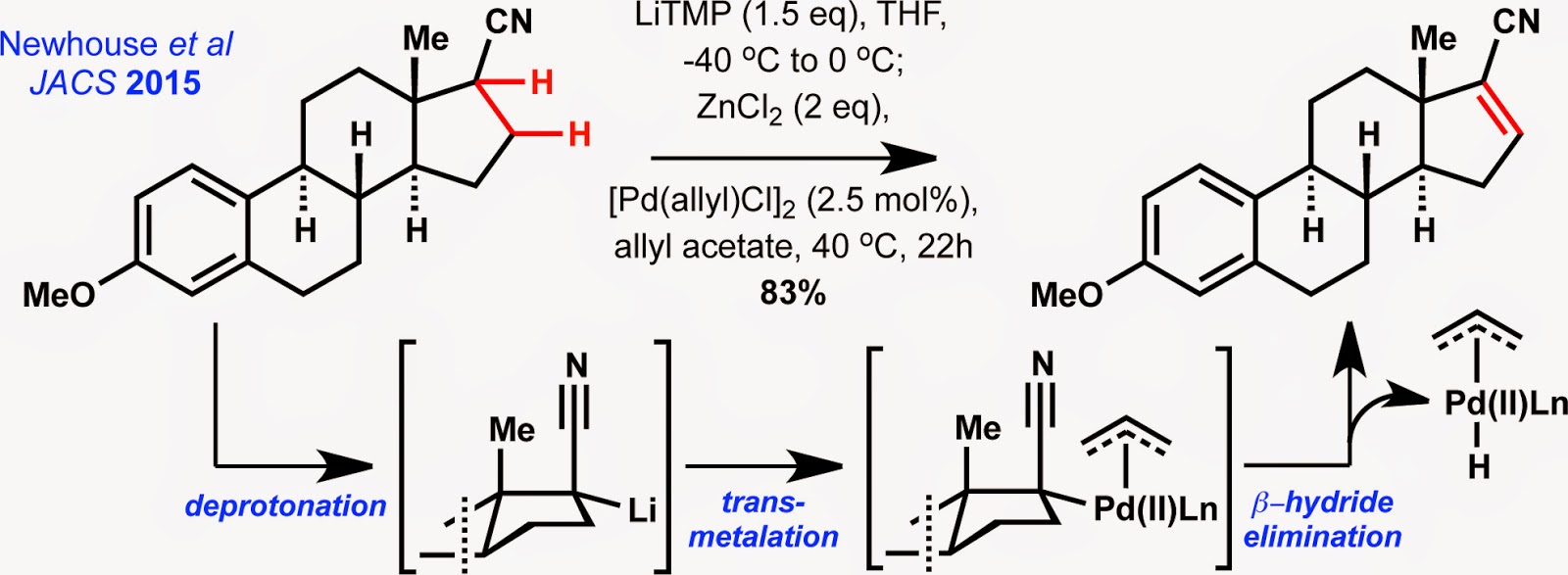
On a somewhat unrelated note, the
laboratory of Timothy Newhouse at Yale University has disclosed a new
palladium-catalyzed methodology for a,b-dehydrogenation
of esters and nitriles. The method nicely complements (and, in some cases, exceeds)
earlier, more classical approaches to achieve a,b-unsaturation
such as the Saegusa-Ito oxidation or the Sharpless selenoxide elimination (later extended by Grieco). The novel
reaction from the Yale group is compatible with nitrile substrates derived from
estrone (shown above), cholesterol and androstenedione-type steroids.

Phil
Baran’s laboratory at The Scripps Research Institute recently disclosed a full
account of their 20-step synthesis of the aglycone of ouabain starting from a
derivative of cortisone. Their general strategy for introduction of the dense
hydroxylation pattern of the target molecule was to ‘redox-relay’ pre-existing
oxidation states that are naturally present within the cortisone framework to
neighboring and distal carbon atoms. For example, using Norrish type II
photochemistry, the C11 ketone oxidation state was effectively relayed to the
angular C19 methyl group through the intermediacy of a cyclobutanol. Oxidative
fragmenation of the cyclobutanol then furnishes the C19-functionalized product.
Baran’s optimization and extension of the Norrish protocol to the problem of functionalization of the unactivated steroid C19 substituent provides a useful and
complementary alternative to more classical tactics, such as those reported years
ago by Barton, as well as Meystre and Heusler from Ciba. A more detailed
analysis of Baran’s partial synthesis of ouabagenin can be found here.
Interestingly,
Baran’s group describes a foray into the realm of medicinal chemistry in their recent
JACS full article. They report the application of the Norrish type II
photochemical C-H functionalization methodology to the synthesis of
C19-hydroxylated analogues of corticosteroid drugs such as clobetasol propionate. The authors indicate a motivation to minimize the undesired
biological effects of glucocorticoid receptor (GR) agonists stemming from
off-target mineralocorticoid antagonism. Unfortunately, the novel clobetasol
analogue 1, synthesized in eleven steps from cortisone acetate, exhibits binding
affinity to GR that is inferior to clobetasol propionate by about an order of
magnitude. While selectivity against the mineralocorticoid receptor is not
reported, 1 does exhibit moderate anti-inflammatory efficacy in a cellular
assay. Baran’s analogues are clearly lacking 9a-halogenation.
The 9a-halogenated glucocorticoid series was first described
in 1953 and has been shown to provide a >10-fold increase in binding
affinity to GR, relative to parent C9-proteo hormones. The synthetic route used
to prepare clobetasol analogue 1 is shown below.
Arguably,
the most robust and practical methodology reported by Baran for semisynthetic cardenolide
modification with applications to therapeutically relevant corticosteroids was
disclosed much earlier. In the Journal of Organic Chemistry, Baran reports a
strategy for systematic deoxygenation of ouabain as a means to obtain important
17b-hydroxyacetyl pregnane-type steroids. Ouabain, by
virtue of its pre-built oxygenation at the C11 position and latent side chain
derivable from the C17 butenolide, is a logical candidate for a synthetic
precursor to various glucocorticoids.
As
proof of this principle, ouabagenin 1,19-acetonide was reductively deoxygenated
(see below) at the C1 position via the intermediacy of a 3,11-dione.
Subsequently, upon exposure of an 11,19-methyl-ketal to thionyl chloride and
pyridine at low temperature, the tertiary hydroxyl group at C14 eliminates to generate an olefinic
intermediate. Catalytic hydrogenation of this intermediate results in a
saturated system with b-hydrogen atoms located at the newly formed stereogenic
ring junction positions. Finally, oxidative manipulation of the a,b-unsaturated lactone moiety affords a 20-oxo-14-iso-pregnane that can be
considered a 19-hydroxylated congener of cortisone acetate. Most of the
synthetic operations described in this manuscript were demonstrated on decagram
scale. For example, the hydrogenation depicted below (step 3) was conducted on
73-gram scale and, ultimately, 4 grams of the 14-isopregnane glucocorticoid
derivative were generated from a single batch run.
This latter synthetic
work was conducted by John S. Baran (i.e.
not Phil) of The Laboratories of G. D. Searle and Co., Chicago, Illinois. The
single author manuscript (see excerpt below) was received by JOC on August, 29,
1963. During this time, the post-World War II era race to synthesize cortisone
was in full swing. Ouabain and strophanthidin were two cardenolides that were
evaluated as feedstock precursors to the newly discovered and
highly sought-after corticosteroid wonder drugs of the 1950s – 1960s. G. D.
Searle, much like other major players in the cortisone race - Merck, Syntex and Upjohn - figured prominantly
in the vitally important steroid research that was ongoing during this time
period.